








Forgot Password?
Please enter your email address to receive a link for resetting your password.
Thank You
You will receive an email with further instructions. Please contact customer support if you need any further assistance.
Please verify your email address
A verification link has been sent to your email to activate your account. The link will be valid for 1 hour.
Please check the spam inbox if you can't find the email. If you still can't find it, we can resend it.
A verification link has been sent to your email 00:00
Lens & Soul | Bill Bernstein Photographing the New York That Came Alive After Dark
 Facebook
 Twitter
 LinkedIn
 Email
Email
There are photographers who document a city, and there are photographers who seem to capture its pulse. For legendary New York photographer Bill Bernstein, the city he encountered in the 1970s was chaotic, unpredictable, creative, and alive. Working with a camera for the Village Voice, Bernstein found himself moving through a New York that was both “falling apart and incredible at the same time,” photographing nightlife, musicians, artists, celebrities, and the communities creating their own worlds downtown.
For fifteen years, Bernstein was also the personal photographer of Paul McCartney, documenting worldwide tours with the kind of access and intimacy that only a sustained relationship makes possible.

At the time, he wasn’t thinking about making history. He was simply paying attention. Decades later, those photographs have become an extraordinary visual record of New York Cit and of the people who found freedom, identity, and belonging in its nightlife.
Finding New York Through a Camera
Bernstein got his start at the Village Voice in the 1970s, carrying his camera through the city and photographing whatever caught his attention.
“I was shooting nightlife, music, artists, whoever was building their own weird little world downtown,” he recalls.
There was no way to know which moments would eventually become part of New York’s cultural history. Bernstein was simply immersed in the city, working, exploring, and trying to make a living.
“It wasn’t until much later that I realized the club pictures had become something of an important record of New York City’s history.”
That instinct to photograph what genuinely pulled him in would become central to his work.

Photographing People Being Themselves
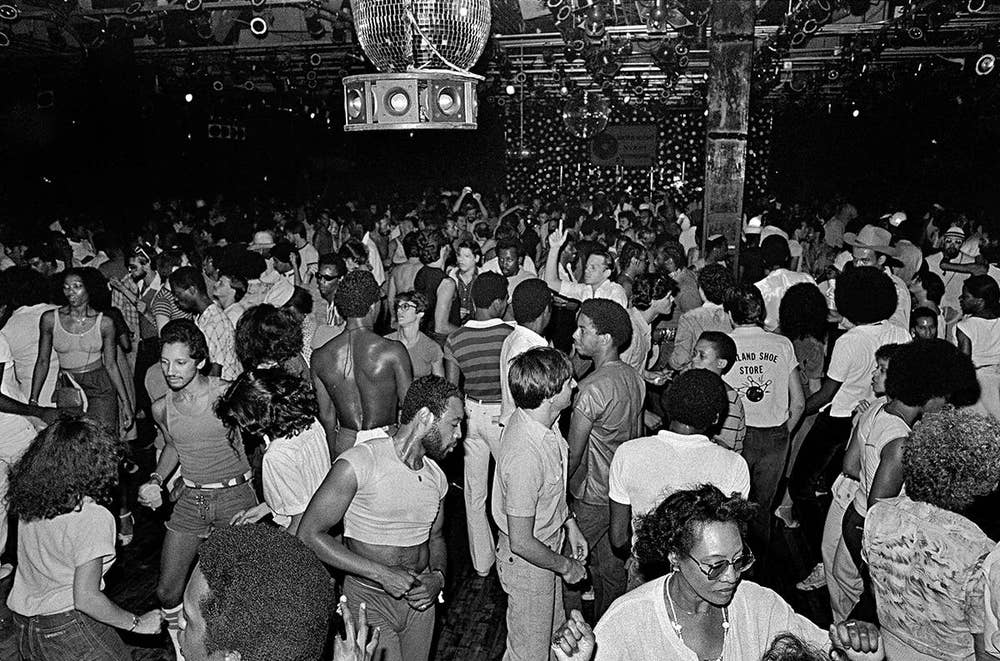
Bernstein’s photographs of New York nightlife are instantly recognizable for their intimacy and honesty. His camera found people on dance floors, backstage, in clubs, and in those fleeting moments when the performance fell away.
“I’ve always been drawn to people and whatever world they’ve built around themselves,” he says. “Somebody on a dance floor at 3am, a musician backstage, a celebrity in the two seconds nobody’s watching them perform. I just want it to feel true, not staged.”
Nowhere is that more evident than in Bernstein’s photographs of the legendary Paradise Garage. His photographs weren’t simply about disco or nightlife. They captured something much deeper: people finding a place where they could exist completely on their own terms. Looking back at the photographs today, Bernstein doesn’t see them simply as pictures of a particular music scene.
“It’s people finding freedom,” he says.
That distinction is important. Bernstein wasn’t trying to define the people he photographed. He was observing them with curiosity and allowing the photographs to speak for themselves.

Inspired by the Night
Bernstein’s approach to photographing New York was shaped by photographers who understood that some of the most revealing stories exist outside the obvious. Early influences included Brassaï and Diane Arbus, two photographers whose work explored people and communities with an extraordinary sense of curiosity.
Other influences included William Klein, whose photographs of crowded city streets demonstrated how chaos could still have structure, and Richard Avedon, whose portraits captured people with a timeless sense of presence. Bernstein carried those influences with him as he photographed New York.
“It was a world unto itself, and I wanted to make pictures that showed it.”

The Photograph Isn’t Finished Until it’s Printed
For a photographer who began his career in the darkroom, the physical photograph remains essential. For Bernstein, photography has never been exclusively about the image captured in the camera. It is also about what happens when that image becomes something tangible.
“Everything, really,” he says when asked about the role printing plays in his work.“I came up in the darkroom, and I still think a photograph isn’t finished until it’s a print you can hold.”
There is something about a physical photograph that a screen cannot replicate, the density of the blacks, the texture of the grain, and the way light interacts with paper.
“There’s a depth and a weight to a good print that a screen just can’t touch.”
That philosophy feels especially meaningful when considering Bernstein’s archive. His photographs have endured not simply as digital files or images circulating online, but as physical records of people, places, communities, and moments that might otherwise have disappeared.
“When somebody buys a print from me, I want them to feel like they’ve got an object, not just an image that’s going to get buried under the next thing on their phone.”

The Importance of Paying Attention
If Bernstein’s photographs offer one lesson, it may be this, pay attention.
“The good pictures usually aren’t the obvious ones,” he says. “You can’t plan for that. You just have to already be standing there when it happens.”
It’s an approach that requires curiosity and patience and a willingness to get out of your own head and simply observe.
“There’s more out there worth paying attention to than most people realize,” Bernstein says. “And you learn a lot just from watching.”
That philosophy has guided a career spanning decades, but it also offers a lesson for photographers at any stage: don’t always chase the obvious photograph. Stay curious. Follow what interests you. Be present enough to recognize the moment when it arrives.

Trust Your Gut
If Bernstein could offer advice to his younger self, it would be simple. “Trust your gut faster, and stop second-guessing it.”
The photographs that have lasted, he says, weren’t necessarily the ones he carefully planned. They were the ones he couldn’t help but make.
“Shoot what actually pulls you in, even when you have no idea if it’ll go anywhere.”
And then there’s another piece of advice that feels particularly relevant in an age when photographs can disappear with a hard drive failure or become buried among thousands of files:
“Keep every negative.”
You never know what will matter decades from now. Bernstein certainly didn’t know when he was photographing New York’s clubs in the 1970s that those images would eventually become part of the historical record of the city. He was simply there, camera in hand, photographing what he saw.
Four decades later, those negatives have become something much more. They are history. They are history. They are a record of people who found freedom on a dance floor, musicians who defined a moment, artists creating their own worlds, and a New York that could only exist in that particular time.
And perhaps most importantly, they are proof of what can happen when a photographer simply pays attention.
Lens and Soul
Bill Bernstein’s photographs remind us that photography isn’t always about anticipating history. Sometimes, it’s about being present enough to recognize it.
The city changes. The clubs close. The people move on. The music fades. But a photograph can hold a moment still—and a print can give that moment a physical life that continues long after the original scene has disappeared.
For Bernstein, that is what makes photography matter. You have to be there. You have to be present. And when something pulls you in, you have to take the picture.