











Forgot Password?
Please enter your email address to receive a link for resetting your password.
Thank You
You will receive an email with further instructions. Please contact customer support if you need any further assistance.
Please verify your email address
A verification link has been sent to your email to activate your account. The link will be valid for 1 hour.
Please check the spam inbox if you can't find the email. If you still can't find it, we can resend it.
A verification link has been sent to your email 00:00
Black and White Photography: How Light and Shadow Tell a Story
 Facebook
 Twitter
 LinkedIn
 Email
Now that the days are shorter, it’s the perfect time to embrace light and shadow. Black and white photography has a timeless beauty, capturing the details, textures and emotions that otherwise might go unnoticed. From soft window light to dramatic shadows stretching across a sidewalk, these contrasts add depth, reveal texture, and transform everyday moments into striking black and white photographs.
The best part? You don’t need professional equipment to get started. Whether you’re using a DSLR, a mirrorless camera, or your smartphone, learning to recognize and work with light can transform your photographs.
Here are five tips to help you capture the beauty of black and white photography and create images worth printing.

Look for Strong Light and Shadows
Light is one of the most powerful tools in black and white photography. Without color, the way light illuminates a subject becomes even more important.
Look for opportunities where light and darkness meet. Sunlight streaming through a window, shadows cast by trees, or the geometric patterns created by buildings can all become compelling photographic subjects.
Try photographing the same scene at different times of day. Morning and late-afternoon sunlight often create longer, softer shadows, while midday sunlight can produce bold, dramatic contrast. Each lighting condition tells a different story.

Embrace Contrast to Create Drama
Contrast is what gives many black and white photographs their visual impact. The difference between bright highlights and deep shadows can draw the viewer’s eye toward your subject and create a sense of mood.
High-contrast images, with bright whites and deep blacks, often feel bold and dramatic. Lower-contrast images, featuring softer transitions between light and dark gray, can feel gentle, nostalgic, or atmospheric.
When editing, experiment with your image’s contrast and black-and-white conversion settings. Be careful not to lose important details in the brightest highlights or darkest shadows.

Use Texture to Add Depth and Interest
When color is removed, texture becomes an important part of the photograph’s story. Surfaces that might seem ordinary in color can become fascinating when their patterns, imperfections, and details take center stage.
Think weathered wood, wrinkled fabric, tree bark, peeling paint, stone walls, or the delicate lines on someone’s hands. Side lighting, which illuminates a subject from the side rather than directly from the front, can emphasize these details by creating small highlights and shadows across the surface.
Texture also helps give a photograph a sense of dimension. Instead of appearing flat, the image invites viewers to explore its details.

Pay Attention to Composition and Negative Space
A strong black and white photograph doesn’t need to be complicated. Sometimes, a simple composition is the most effective way to communicate an idea or emotion.
Look for leading lines, repeating patterns, architectural shapes, and natural frames. A row of windows, a winding path, or the outline of a tree can guide the viewer’s eye through the image.
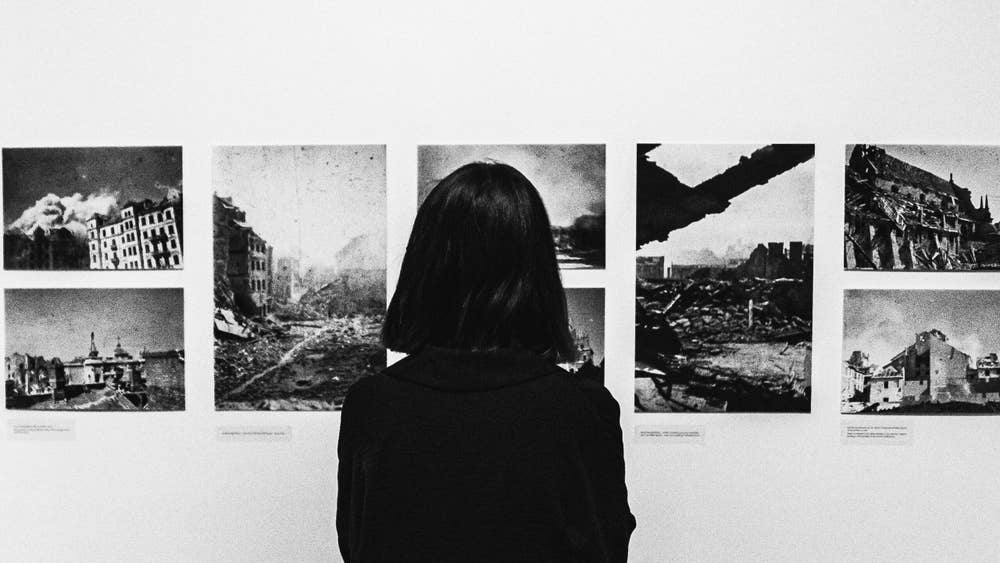
Negative space, or the empty area surrounding your subject, can be just as important. A single person standing against a large, uncluttered wall can convey solitude, while a small subject surrounded by light and shadow can create a sense of scale.

Think About the Print
A photograph can look beautiful on a screen, but seeing it as a physical print offers an entirely different experience. You can appreciate the subtle tonal transitions, fine details, and depth of a black and white image without the distractions of notifications or other digital content.
When preparing an image for printing, pay close attention to exposure, contrast, and shadow detail. Make sure the important parts of the photograph remain visible, particularly in areas that are very dark or bright. Remember that screens emit light, while prints reflect it, so an image may look different on paper than it does on your device.
Consider the final size and finish, too. A large black and white print can make a dramatic statement on a living room wall, while a series of smaller prints can create a cohesive gallery wall. A photo book is another beautiful way to bring together images from a trip, a family gathering, or a personal photography project.

The beauty of black and white photography lies in its simplicity. By removing color, you can focus on the elements that make an image meaningful: light, shadow, texture, composition, and emotion.
Start by noticing the light around you. Experiment with different angles, embrace shadows, and look for beauty in everyday details. You may be surprised by how many compelling photographs are waiting to be discovered in familiar places.
And when you capture an image you love, consider giving it a permanent place in your home. With professional-quality photo printing from Printique, your favorite black and white photographs can become timeless prints that celebrate the beauty of light and shadow for years to come.