If you recently took a dive into our last blog with longtime printer and friend of Printique, Daryna Barykina., you already know her work has expanded far beyond traditional commercial photography.
For years, Daryna worked inside what she calls the “content machine” an endless cycle of high-speed production and high-volume imagery that left little room for personal expression. Shooting professionally for brands requires incredible efficiency. Campaign imagery, product photography, and social media content must be produced quickly and consistently.
“The speed and quality at which you need to produce is insane,” she explains.
After spending her days creating professional imagery for an in-house role, picking up a camera for herself began to feel less like a passion and more like another task.
But the silence didn’t last.
One evening, while watching a movie, Daryna instinctively reached for her phone—not for a client, not for a deadline, but simply to create. The portrait she captured of her husband was geometric, haunting, and raw. That image became the turning point: the moment she transitioned from a high-volume content creator back to a fine art photographer focused on intentional image-making and museum-quality printing.
For photographers exploring fine art printing, gallery presentation, and archival photo printing, Daryna’s journey offers insight into how slowing down can reconnect artists with their creative voice.
Like many working photographers, Daryna still lives partially inside the commercial world. By day, she works as Director of Content at a beauty brand, collaborating across teams to develop high-impact visual campaigns.“In that world, every piece of work is a collaboration,” she explains. “There’s no sole owner, we all contribute to create something impactful.”
While collaboration can be powerful, it can also make it difficult for a photographer to maintain full creative ownership.Fine art photography became the space where she could reclaim that control.Her current creative direction reflects a desire for autonomy, escapism, and a slower pace of life.
Slowing down allowed her to ask a simple but powerful question:
What do I actually want my art to do for people?
Her answer: comfort and presence.
Much of her work now transforms ordinary objects into meditative visual experiences. She frequently uses trompe l’oeil techniques, creating images that shift between illusion and reality.“I want people to look at my work for a long time without getting tired of it,” she says. “I want it to make them feel relaxed.”
For photographers wondering how to transition from commercial photography to fine art photography, her advice is simple: Slow down enough to hear your own voice again.
Choosing the Right Print Medium
When photographers first enter the world of fine art printing, one of the biggest questions is: What is the best medium to print photography on?
For her project Study #1: The Atlantic Limon, Daryna experimented with HD Metal Prints, produced through dye-sublimation on aluminum. The test print was created on silver satin aluminum, a surface that subtly reflects light through the image.The result surprised her. “To fight the digital flatness of a screen, I needed a medium that could show the glow of the subject and the reflective qualities of the water.” Metal printing achieved that beautifully.
Unlike traditional photo printing, where ink sits on the surface—dye-sublimation infuses the image directly into the aluminum sheet, allowing highlights to glow while maintaining deep tonal contrast. What she loves most about the material is the tension between strength and luminosity.
The brushed aluminum feels almost brutal but at the same time the image glows from within. – Daryna
That high gloss is one reason many professional photographers choose metal for:
Contemporary gallery exhibitions
Large-scale photographic artwork
Modern interior installations
High-contrast fine art photography
The Importance of Size in Fine Art Printing
Another major consideration in fine art photography is print size. Images behave very differently when enlarged.Negative space that feels intentional on a screen can suddenly appear empty when printed large. Small subjects can lose their visual weight.
For her first test print, Daryna chose 30×40 inches.The size gave her room to evaluate the composition and determine whether the work could scale even larger for exhibition.This step is essential for photographers preparing work for gallery shows, collectors, or fine art sales.
Why Surface Texture Matters
One of the most common questions photographers ask is: What is the best paper for Giclée prints?
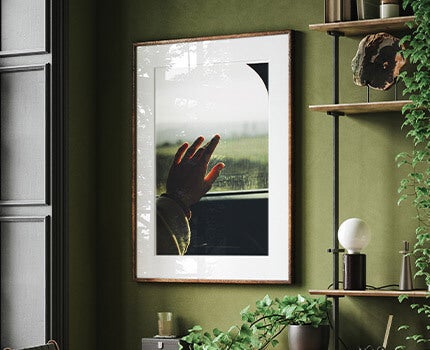
For her intimate smartphone portrait series, Daryna experimented with Giclée printing on textured fine art papers.Unlike standard luster prints, these materials add tactile depth to the image.Texture, tone, and reflectivity all influence how a viewer emotionally experiences the photograph.But choosing the right surface isn’t just about aesthetics.
Photographers also need to consider:
Gallery lighting conditions
Natural vs artificial light
Framing and glazing
Surrounding wall colors
Viewer distance
Her approach is practical: Create multiple test prints and study them in real environments. Material and framing can elevate a piece or make it look cheap. The print medium is a continuation of the work.
Creating Space for Personal Work
Daryna also reflected on the experience many women photographers share today: balancing professional ambition with personal creative fulfillment.
Her long-term goal is to build a life that allows for more peace, slower creative work, and meaningful artistic moments.For photographers feeling creatively drained by the demands of constant digital content production, she offers two pieces of advice.
Keep a Passion Project
Have something you create purely for joy. A project that exists outside of client work can become a mental escape—and a powerful creative engine.
Trust Your Technique When Inspiration Fades
Not every creative moment will feel inspired.Sometimes the work moves forward through discipline and craft.
And in today’s saturated creative landscape, originality matters more than ever. Instead of copying other photographers, she recommends studying the brands or audiences you want to serve. Brands want something unique. They don’t want what their competitors already have.
The Role of Printing in Her Creative Process
For many photographers, printing is the final step.For Daryna, it’s part of the creative process itself. She often begins by printing an image on fine art paper, then re-photographing the print through layers of distortion—water, glass, or other materials. Sometimes it takes two or three cycles of printing and shooting to achieve the final result. This hybrid process allows her to extract more emotional depth from the subject. In other words: Printing isn’t just presentation. It’s transformation.
Final Thoughts
For photographers who spend most of their time in digital workflows, stepping into the world of fine art photo printing can feel intimidating.But printing unlocks a new dimension of photography. It reveals details you can’t see on a screen. It forces decisions about scale and material. And it transforms photographs into objects with presence. For Daryna, printing became the bridge back to creative freedom. By slowing down and embracing physical mediums—from aluminum prints to textured fine art paper—she rediscovered the reason she started making images in the first place.
And sometimes, that’s exactly what photographers need.




 Facebook
 Twitter
 LinkedIn
 Email
Email


